
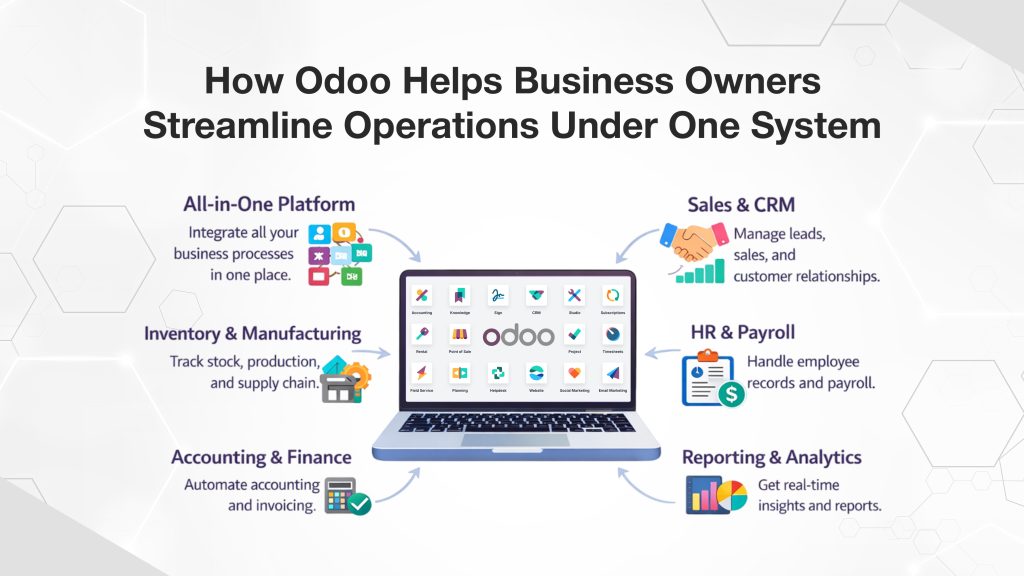
In today’s fast-paced business environment, managing multiple processes across sales, finance, inventory, HR, and customer service can quickly become overwhelming. Many business owners find themselves juggling multiple software tools, spreadsheets, and disconnected systems, leading to inefficiencies, errors, and wasted time.
This is where Odoo business management and the Odoo ERP system make a real difference. By bringing all critical business operations under one integrated platform, Odoo enables businesses to streamline operations, improve collaboration, and make faster, smarter decisions.
In this article, we’ll explore how Odoo streamlines business operations, the key modules that drive efficiency, and why it is the preferred all-in-one ERP software for modern businesses.
The Challenge: Fragmented Business Operations
Most growing businesses struggle with disconnected systems. Some common issues include:
- Separate software for accounting, inventory, and CRM
- Manual data entry across multiple platforms
- Lack of real-time insights into operations
- Time-consuming reporting and approvals
- Difficulties in scaling business processes
These inefficiencies not only increase operational costs but also slow down decision-making, impacting growth and competitiveness.
Odoo ERP system addresses these challenges by consolidating business processes under one platform, making operations smoother, faster, and more transparent.
What Makes Odoo an Effective Business Management Tool?
Odoo business management stands out because of its modular and flexible approach. Unlike traditional ERP systems, which are often rigid and costly, Odoo allows businesses to start with the modules they need and expand as they grow.
Key characteristics include:
- All-in-one ERP software: Combines multiple business functions under one system
- Cloud-based and accessible anywhere: Enables remote teams to collaborate effectively
- Highly customizable workflows: Tailored to specific business needs
- Unified database: Reduces errors and ensures consistency across departments
By integrating all processes into a single platform, Odoo empowers business owners to manage operations efficiently, without the chaos of disconnected tools.
Key Odoo Modules for Streamlining Operations
One of the main reasons businesses adopt Odoo is its modular design. Each module addresses a specific business need, yet all modules work seamlessly together. Here are the most impactful modules for operations management:
1. Sales and CRM Module
- Automates sales pipelines and lead management
- Tracks customer interactions and communications
- Integrates with invoicing and inventory for seamless order processing
Benefit: Business owners get real-time visibility into sales performance and customer engagement, enabling better decisions and faster order fulfillment.
2. Inventory and Warehouse Management
- Monitors stock levels and product movements
- Supports automated reordering and inventory optimization
- Integrates with sales and purchasing for real-time updates
Benefit: Reduces stockouts, overstocking, and manual tracking errors, improving operational efficiency.
3. Accounting and Finance
- Automates invoicing, payments, and financial reporting
- Supports multi-currency and multi-company operations
- Tracks budgets, expenses, and cash flow in real-time
Benefit: Provides complete financial transparency and eliminates the need for multiple accounting tools.
4. Human Resources (HR) Management
- Manages employee records, attendance, and payroll
- Streamlines recruitment and performance appraisals
- Tracks leaves, expenses, and internal communications
Benefit: Reduces administrative burden on HR teams and ensures compliance with company policies and regulations.
5. Project and Task Management
- Organizes tasks, projects, and deadlines in a single dashboard
- Assigns responsibilities and tracks progress
- Integrates with timesheets and billing for project-based businesses
Benefit: Enhances team collaboration and ensures projects are delivered on time.
6. Manufacturing and Production
- Automates production planning and work orders
- Tracks raw materials and finished goods in real time
- Integrates with inventory, sales, and procurement
Benefit: Optimizes manufacturing workflows and reduces production bottlenecks.
7. Marketing and Communication
- Manages email campaigns, SMS, and social media
- Tracks campaign performance and leads
- Integrates marketing activities with sales and CRM
Benefit: Provides a unified view of marketing effectiveness and helps convert leads into customers more efficiently.
How Odoo Streamlines Business Operations
With all modules connected in a single system, Odoo workflow automation transforms the way businesses operate. Here’s how:
- Eliminates Redundant Processes: No need to enter data multiple times across different systems. One entry updates all relevant modules.
- Improves Collaboration: Teams across sales, finance, inventory, and HR work in the same system, reducing miscommunication.
- Provides Real-Time Insights: Dashboards and reports offer instant visibility into operations, helping business owners make informed decisions.
- Reduces Errors: A unified database ensures data consistency, reducing mistakes and delays.
- Enhances Scalability: As the business grows, new modules can be added without disrupting existing operations.
In short, Odoo helps business owners manage business in one system using Odoo, creating a seamless operational environment that drives efficiency and growth.
Benefits of Using Odoo for Operations Management
- Time Savings: Automated processes and centralized data reduce manual work.
- Cost Efficiency: Less dependency on multiple software tools and fewer human errors.
- Flexibility: Customize workflows to match your business processes.
- Better Decision-Making: Real-time insights lead to faster, more accurate decisions.
- Growth Enablement: Supports expansion without the need to switch systems.
These advantages make Odoo one of the most trusted platforms for modern businesses seeking to optimize operations under a single system.
Why Odoo Is the Choice for Modern Business Owners
Business owners today need systems that are flexible, scalable, and efficient. Odoo provides:
- An integrated approach: All business operations in one system
- Automation of repetitive tasks: Reducing errors and freeing up staff time
- Real-time collaboration: Teams can work together efficiently from anywhere
- Data-driven decision-making: Reports and dashboards provide actionable insights
By leveraging Odoo for operations management, businesses can transform chaotic workflows into a streamlined, transparent, and productive environment.
Conclusion: Unlocking Operational Excellence with Odoo
The modern business landscape demands efficiency, agility, and integration. Managing multiple systems, spreadsheets, and software tools is no longer viable for growing businesses.
Odoo ERP system offers a powerful solution, combining modules for sales, inventory, finance, HR, manufacturing, and marketing into a single, unified platform. With business process automation, workflow customization, and real-time insights, Odoo empowers business owners to streamline operations under one system—saving time, reducing errors, and driving growth.
For businesses looking to simplify operations, improve collaboration, and make data-driven decisions, Odoo is not just software—it is the backbone of modern business management.