
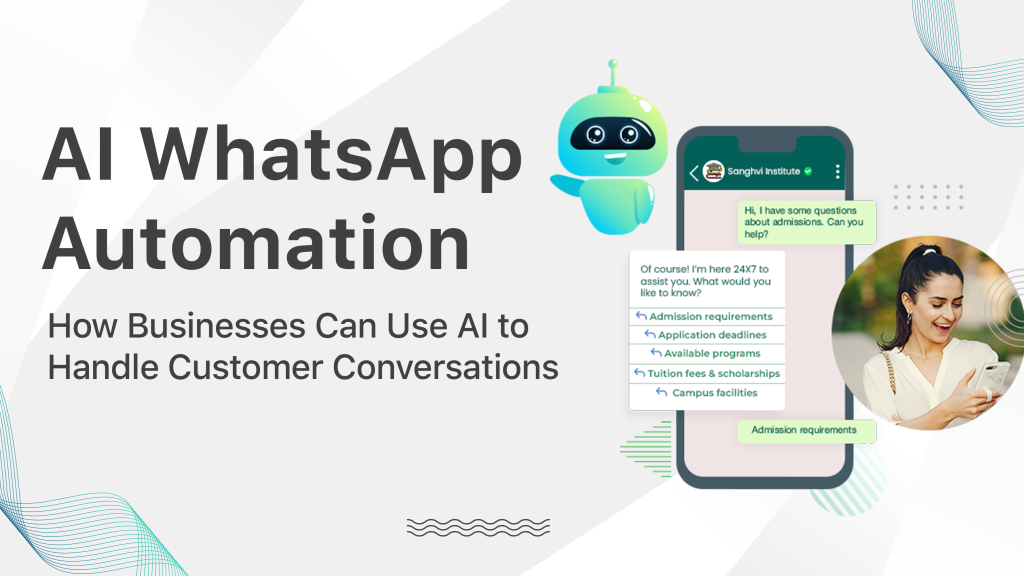
Customer communication has changed dramatically over the last decade. Businesses that once relied on phone calls and emails now interact with customers primarily through messaging platforms. Among these platforms, WhatsApp has become one of the most powerful communication channels for businesses around the world.
With billions of users and extremely high message engagement rates, WhatsApp allows companies to communicate with customers instantly. However, as businesses grow and the number of incoming messages increases, manually managing every conversation becomes difficult.
This is where AI WhatsApp automation is transforming customer communication.
By combining artificial intelligence with messaging platforms, businesses can build intelligent systems capable of understanding customer questions, providing relevant responses, and even completing transactions automatically.
An AI WhatsApp chatbot can handle thousands of conversations simultaneously, helping companies deliver faster support while reducing operational costs.
In this guide, we will explore how AI customer support automation works, how it differs from traditional chatbots, and how businesses can use AI-powered WhatsApp automation to improve customer experience and streamline operations.
Evolution of Customer Support
Customer support has evolved significantly as technology has advanced.
In the past, businesses relied heavily on call centers and email-based support systems. Customers would call customer service departments and wait in long queues to speak with a representative. Email support, while convenient, often resulted in delayed responses.
As digital communication platforms grew, companies began adopting live chat systems on websites to provide faster assistance. These systems allowed businesses to respond to customer questions in real time.
However, live chat support still required human agents to be available constantly.
The rise of messaging platforms like WhatsApp changed the way businesses communicate with customers. Customers prefer messaging because it is fast, convenient, and familiar.
Businesses quickly realized the importance of providing support through WhatsApp, but this created a new challenge — managing large volumes of conversations.
To address this challenge, companies began using chatbots to automate responses. Early chatbot systems were simple and rule-based, capable of answering basic questions but limited in their ability to understand natural language.
Today, artificial intelligence has dramatically improved chatbot capabilities. Modern AI WhatsApp chatbots can understand context, interpret customer intent, and provide intelligent responses that closely resemble human conversations.
This evolution has enabled businesses to automate a large portion of their customer communication.
Traditional Chatbots vs AI Chatbots
While both traditional chatbots and AI-powered chatbots automate customer conversations, they differ significantly in their capabilities.
Understanding this difference helps businesses recognize the value of AI-driven automation.
Traditional Rule-Based Chatbots
Traditional chatbots operate using predefined rules and decision trees.
These systems follow a structured flow where users must choose options from menus or provide specific keywords to receive responses.
For example:
Customer: “I want to track my order.”
Chatbot:
“Please select an option:
- Track order
- Cancel order
- Contact support”
While rule-based chatbots can handle simple queries, they have several limitations:
- They cannot understand natural language variations.
- They require users to follow strict conversation paths.
- They struggle with complex questions.
- They often create frustrating user experiences.
If a customer asks a question outside the predefined flow, the chatbot usually fails to respond properly.
AI-Powered Chatbots
AI chatbots use technologies such as natural language processing (NLP) and machine learning to understand user intent and generate relevant responses.
An AI WhatsApp chatbot can interpret customer messages even when they are phrased differently.
For example:
Customer messages like:
- “Where is my order?”
- “Can you tell me my delivery status?”
- “I want to check shipping details.”
All represent the same intent. AI systems recognize this intent and provide appropriate responses.
AI chatbots can also:
- handle more complex conversations
- provide personalized responses
- retrieve information from databases
- learn from past interactions
This makes AI chatbots far more effective for handling real-world customer conversations.
What AI WhatsApp Automation Can Do
AI-powered WhatsApp automation enables businesses to manage customer communication at scale while maintaining a personalized experience.
Below are some of the most powerful capabilities of AI WhatsApp automation.
Intelligent Customer Conversations
AI chatbots can understand customer questions and provide accurate responses instantly.
Instead of relying on rigid menu-based interactions, customers can communicate naturally.
For example:
Customer:
“Do you have this product available in blue?”
The AI system can analyze the message, identify the product, check inventory data, and respond accordingly.
24/7 Customer Support
One of the biggest advantages of AI automation is the ability to provide round-the-clock customer support.
Unlike human agents, AI chatbots can operate continuously without breaks.
This ensures customers receive immediate responses regardless of time zones or business hours.
Personalized Customer Interaction
AI systems can access customer data stored in CRM platforms to personalize conversations.
For example, the chatbot may recognize returning customers and provide tailored responses based on previous interactions or purchase history.
Personalized communication improves customer satisfaction and strengthens relationships.
Automated Task Execution
Beyond answering questions, AI chatbots can perform actions such as:
- placing orders
- scheduling appointments
- updating customer information
- retrieving order status
This transforms chatbots from simple communication tools into intelligent automation systems.
Use Cases of AI WhatsApp Automation
AI WhatsApp automation can benefit businesses across many industries. Below are some of the most common and impactful use cases.
eCommerce Customer Support
Online retailers often receive large numbers of customer inquiries related to products, orders, and shipping.
AI WhatsApp chatbots can handle many of these requests automatically.
For example, customers may ask:
- product availability
- product details
- pricing information
- shipping timelines
- return policies
The AI system can instantly provide accurate information and guide customers through the purchasing process.
It can also assist with order tracking by retrieving shipping data from the order management system.
This reduces the workload on support teams while ensuring customers receive quick responses.
Booking and Appointment Systems
Service-based businesses frequently require appointment scheduling.
Examples include:
- healthcare clinics
- consulting firms
- beauty salons
- educational institutions
- repair services
AI-powered WhatsApp automation can manage the entire booking process.
Customers can:
- check available time slots
- book appointments
- receive confirmations
- get automated reminders
The AI system can also reschedule or cancel appointments when requested.
This eliminates manual scheduling tasks and improves operational efficiency.
Customer Onboarding
Many businesses need to guide new customers through onboarding processes.
This may include:
- account setup
- service activation
- document submission
- product tutorials
AI chatbots can automate onboarding by guiding users step-by-step.
For example, a new customer might receive a message asking them to provide basic information. The AI system can collect the data, verify documents, and create user profiles automatically.
This ensures new customers get started quickly without requiring manual assistance.
FAQs Automation
Customer support teams often spend a large amount of time answering frequently asked questions.
Examples include:
- pricing inquiries
- business hours
- service availability
- product specifications
- refund policies
AI chatbots can automatically respond to these common questions.
Because AI systems understand natural language, customers can ask questions in their own words and still receive accurate responses.
This significantly reduces the number of repetitive queries handled by human agents.
AI + WhatsApp + CRM Workflow
One of the most powerful aspects of AI customer support automation is its ability to integrate with other business systems.
When AI chatbots are connected with CRM platforms and internal databases, they can create intelligent workflows that automate entire customer journeys.
A typical AI + WhatsApp + CRM workflow might look like this:
Step 1: Customer Sends a WhatsApp Message
A potential customer sends a message asking about a product or service.
The AI chatbot receives the message and analyzes the customer’s intent.
Step 2: Customer Data is Retrieved
The system checks the CRM database to determine whether the customer has interacted with the company before.
If the customer already exists in the CRM system, the chatbot retrieves their previous interaction history.
Step 3: AI Responds with Relevant Information
Based on the customer’s question, the AI system provides appropriate information.
For example:
- product details
- pricing
- service options
Step 4: Lead is Created or Updated in CRM
If the user is a new prospect, the system automatically creates a new lead in the CRM system.
Relevant information such as:
- name
- contact details
- conversation history
is stored for future follow-ups.
Step 5: Sales Team Notification
If the AI chatbot detects strong purchase intent, the system can notify the sales team automatically.
Sales representatives can then take over the conversation and guide the customer toward completing a purchase.
This workflow ensures that customer conversations seamlessly transition from automation to human interaction when needed.
Real Business Benefits of AI WhatsApp Automation
Implementing AI WhatsApp automation offers several significant advantages for businesses.
Faster Customer Response Times
AI chatbots can respond to customer inquiries instantly. This eliminates waiting times and improves the overall customer experience.
Fast responses also increase the likelihood of converting inquiries into sales.
Reduced Support Costs
By automating repetitive conversations, businesses can significantly reduce the workload on support teams.
Human agents can focus on complex issues while AI systems handle routine inquiries.
This reduces operational costs without compromising service quality.
Scalability
As businesses grow, the volume of customer inquiries increases.
Hiring large support teams is expensive and difficult to scale.
AI chatbots allow businesses to handle thousands of conversations simultaneously without increasing staffing requirements.
Improved Lead Conversion
AI chatbots can engage potential customers immediately when they inquire about products or services.
By providing instant responses and guiding users through the buying process, businesses can increase lead conversion rates.
Better Customer Insights
AI systems can analyze customer conversations to identify common questions, concerns, and preferences.
This data provides valuable insights that help businesses improve their products, services, and communication strategies.
Final Thoughts
Messaging platforms have become the primary communication channel between businesses and customers. As WhatsApp continues to grow as a business communication tool, companies must find ways to manage conversations efficiently.
Manual messaging processes are difficult to scale and often lead to slow response times.
By implementing AI WhatsApp automation, businesses can transform customer communication into a fast, intelligent, and scalable system.
AI-powered chatbots can handle customer inquiries, automate repetitive tasks, assist with sales processes, and integrate with internal systems such as CRM platforms.
From eCommerce customer support and appointment scheduling to onboarding and FAQ automation, AI-powered messaging systems offer a wide range of possibilities for businesses looking to improve efficiency and customer experience.
Companies that adopt AI customer support automation early will be better positioned to deliver faster service, reduce operational costs, and build stronger relationships with their customers in an increasingly digital world.

20 Responses